
Town guide / South Manchester and Stockport
Victorian furniture for Didsbury homes
Didsbury has a village centre and a long run of tree-lined roads, with many large Victorian and Edwardian houses beside later homes. Victorian furniture was made for rooms of exactly this kind.
i.
The houses
Bigger period houses often have high ceilings and tall windows, which gives a substantial piece such as a cabinet or sideboard room to breathe. Flats and conversions in the same buildings can be different, with smaller rooms and narrower stairs, so measure the route into the house as well as the space where the piece will stand.
ii.
Victorian furniture in that setting
Victorian furniture tends to be solid and well made, with turned legs, carved details and deep drawers. Look at the condition of the veneer and the drawer linings, and ask Sara what repairs a piece has had. Heavy pieces can often be dismantled in part for delivery, but that is something to agree piece by piece.
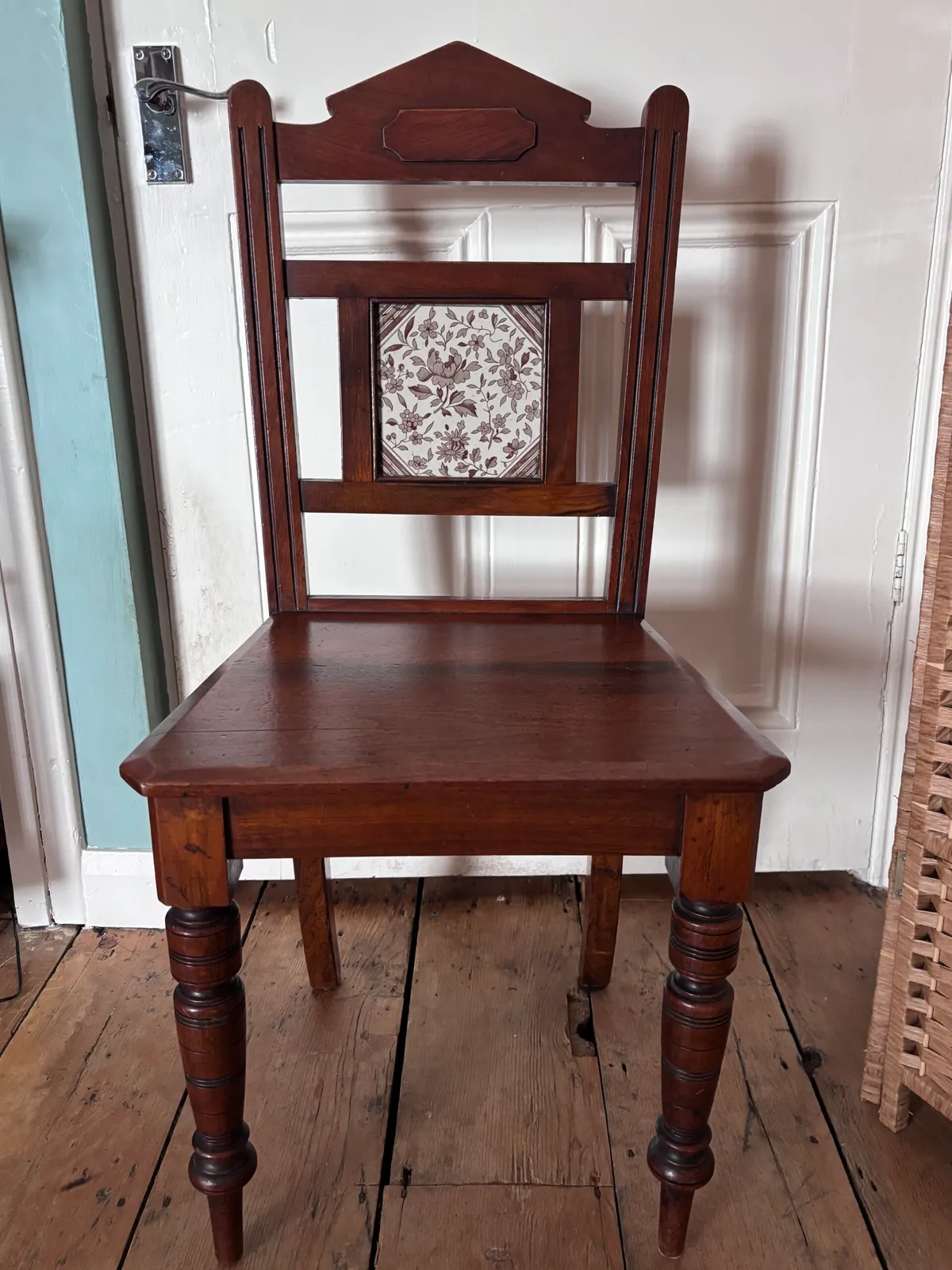
No.06
Hall chair
- Timber
- Hardwood
- Period
- c. 1880 to 1900, as listed
Priced on Creative Caernarfon. Ask Sara whether it is still here.
Photographed in the collection, Plate 06
Victorian Chair with Decorative Tile Back
Aesthetic Movement chair with a floral ceramic tile set into the back, clean geometric lines and turned front legs. Listed in good antique condition with wear consistent with age.
One-off. Ask whether it is still available.
Ask Sara about this pieceiii.
Buying from Caernarfon
Didsbury is in south Manchester and Life: Full Colour is in Caernarfon, with no branch in between.
Buying works the same way from anywhere: find a piece, ask Sara about it by the enquiry form or on 01286 400155, and buy through Creative Caernarfon.
Visiting and delivery
Life: Full Colour is based at 9 Segontium Terrace, Caernarfon LL55 2PN. Ask Sara whether delivery or viewing is possible for a particular piece.
Victorian furniture listed on Creative Caernarfon
- Victorian Chair with Decorative Tile Back (opens in a new tab)
- Victorian Mahogany Wind-out Dining Table with Eight Chairs (opens in a new tab)
One-off pieces: ask Sara whether a listing is still available.
iv.
Questions for a Didsbury buyer
It can be, because many Victorian pieces were built for large rooms with high ceilings. Measure the wall space, the ceiling height and the route in through doors and up stairs, then ask Sara for the full dimensions of any piece you like before you decide.
Yes, if it is in sound condition. Victorian pieces were made to be used every day, and many have already done a century of it. Ask Sara about the drawers, the hinges and any past repairs so you know what to expect from daily use in a family home.
Keep it out of direct sun and away from radiators, which dry and lift veneer. Dust with a soft cloth and use a good wax occasionally. If a corner is lifting, have it glued back by a restorer before it breaks away.
They help but do not prove it. Labels can be added, moved or replaced, so look at them with the construction and wear. A label that matches the piece in age and condition is more reassuring than one on a clean, new-looking surface.
Small chips are common and do not necessarily affect strength. A missing piece shows as a clean gap or a glued patch that may differ in colour. Judge whether it spoils the overall look, and whether it affects anything structural.
Check that the parts sit together firmly, with matching colour and wear along the join. Fixings should feel secure rather than stripped or loose. Ask Sara what she can tell you about how the sections separate and whether they belong together.
Spots and cloudy patches in old mirror glass come from the silvering ageing, which is normal. Some people like the soft look, while others find it distracting. Check that the frame is secure and that the glass is not cracked.
It might be a later replacement, or it may simply have faded differently in sun or been cleaned. Compare the grain and the inside of the drawer with its neighbours. A mismatch is worth noting, though it is not necessarily a defect.
Only roughly. The Victorian period runs from 1837 to 1901, and styles overlapped and were revived, so an exact year is rarely possible and mid or late Victorian are informed estimates. Ask Sara what she can tell you about a piece's likely period.
Both are possible. Wax, polish and dust gather in carving over the years and can look like original darkening. A soft cloth in an unseen spot can show whether it lifts, while a smooth, even dark colour is more likely to be the finish.