
Town guide / Wirral and Merseyside
A blanket chest for a Moreton bedroom
Moreton sits on the low, flat land of the north Wirral coast, not far from Leasowe Lighthouse, and much of its housing dates from the twentieth century. A blanket chest is one of the easiest period pieces to bring into homes like these.
i.
The houses
Interwar and post-war semis and bungalows tend to have moderate rooms, standard ceiling heights and straight, manageable stairs. Floor space is precious, so a piece that stores bedding and doubles as a seat earns its place. Homes near the coast can have more moisture in the air than those inland, and a chest pushed against a cold outside wall may start to smell musty inside if air cannot circulate.
ii.
Blanket chests in that setting
A blanket chest is essentially a box with a hinged lid; with drawers beneath it is often called a mule chest, and small Welsh examples are known as a coffer-bach. Look at the hinges and lid edge for old splits, check whether a small lidded till survives inside, and see whether the lid stays open safely. Ask Sara for the internal depth so you know what will actually fit.
No.07
Mule chest
- Period
- Vintage, as listed
Priced on Creative Caernarfon. Ask Sara whether it is still here.
Photographed in the collection, Plate 07
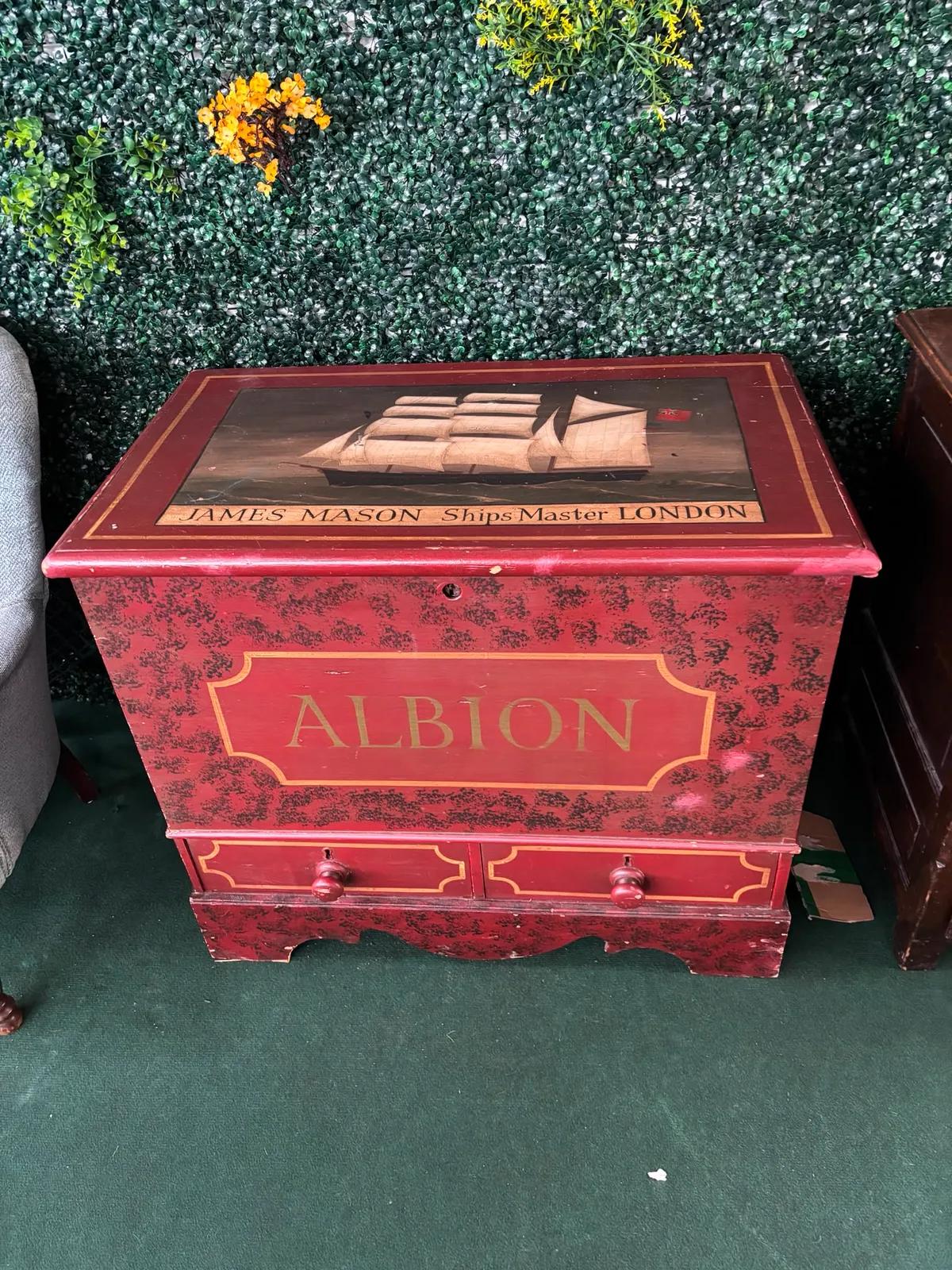
Nautical Mule Chest
A painted mule chest with a sailing ship on the lid and two drawers below the well.
One-off. Ask whether it is still available.
Ask Sara about this pieceiii.
Buying from Caernarfon
Life: Full Colour is in Caernarfon, not on the Wirral, and has no local branch.
Buying works the same way from anywhere: find a piece, ask Sara about it by the enquiry form or on 01286 400155, and buy through Creative Caernarfon.
Visiting and delivery
Life: Full Colour is based at 9 Segontium Terrace, Caernarfon LL55 2PN. Ask Sara whether delivery or viewing is possible for a particular piece.
Blanket chests listed on Creative Caernarfon
One-off pieces: ask Sara whether a listing is still available.
iv.
Questions for a Moreton buyer
Heavy lids can drop, and old chests have no soft-close mechanism. If children are about, ask Sara whether a chest has a lid stay fitted or could take one discreetly, and think about placing it in a room where small children are not left alone with it.
Often, yes. Coffer-bach is the Welsh name for a small coffer, so it takes less floor than a full blanket chest and sits easily at the foot of a single bed or under a window. Ask Sara for its length and depth, and whether the handles, hinges and lock are original.
A musty smell usually comes from years of closed storage. Airing the chest with the lid open in a dry room, out of direct sun, often helps over time. Avoid soaking the interior with water. Some owners line the base with acid-free paper before storing textiles. Ask Sara about the interior before you buy.
Leave enough clear floor to open the lid fully and stand in front of it, usually the depth of the chest plus a stride. At the foot of a bed, check the footboard and the arc of the lid. Ask Sara for the depth and the height with the lid raised.
A gap of a few centimetres lets air move behind the chest and gives the lid room to rise without hitting the wall. Check for any skirting board or radiator pipe that stops it sitting back. Leave the chest slightly forward rather than pushed tight.
A mule chest has a lidded well on top and drawers beneath, so you need space to lift the lid and to pull the drawers out. Measure the depth of the chest, add the length of a drawer, and check the total against your floor space.
Blanket chests are usually a practical size for the end of a bed or a landing, but small rooms still need checking. Measure the wall, then leave room for the door to open and a person to walk past. A Coffer-bach may suit better.
It can, provided the hall is wide enough to pass the chest comfortably with the lid closed. The chest then doubles as a seat or a place for shoes and bags. Check that the front door and interior doors still open fully with it in place.
It can work, and many owners do, but the lid is not built for heavy loads or hot mugs. A tray protects the surface, and the contents inside stay accessible only if you can move things off first. Ask Sara about the lid and hinges on a piece.
Under a window, at the end of a sofa or against a plain wall are all common spots. Check that the lid can open without hitting the window sill or a lamp. Chests in the living room often hold blankets and throws close at hand.