
Town guide / Cheshire market towns
Country furniture for a Macclesfield home
Macclesfield made its name in silk, and the town still carries that history in its mills, its steep streets and the weavers' cottages with long rows of garret windows on the top floor.
i.
The houses
Those garret rooms were built for light to work by, so they tend to be bright, long and low under the roof, while the rooms below are often small. Elsewhere you will find Victorian terraces, larger stone and brick houses towards the hills, and farmhouses out on the edge of the Peak District. Houses on higher ground can run cooler in winter, which old timber tolerates well if changes are gradual.
ii.
Traditional country furniture in that setting
Traditional country furniture, the plain, sturdy pieces made for farmhouses and cottages, suits these rooms because it was made for rooms much like them. Chairs, stools, small chests and low dressers sit comfortably under a garret roof. Measure the height at the wall as well as in the middle of a sloping room, and ask Sara for the overall height of any piece with a raised back or rack.
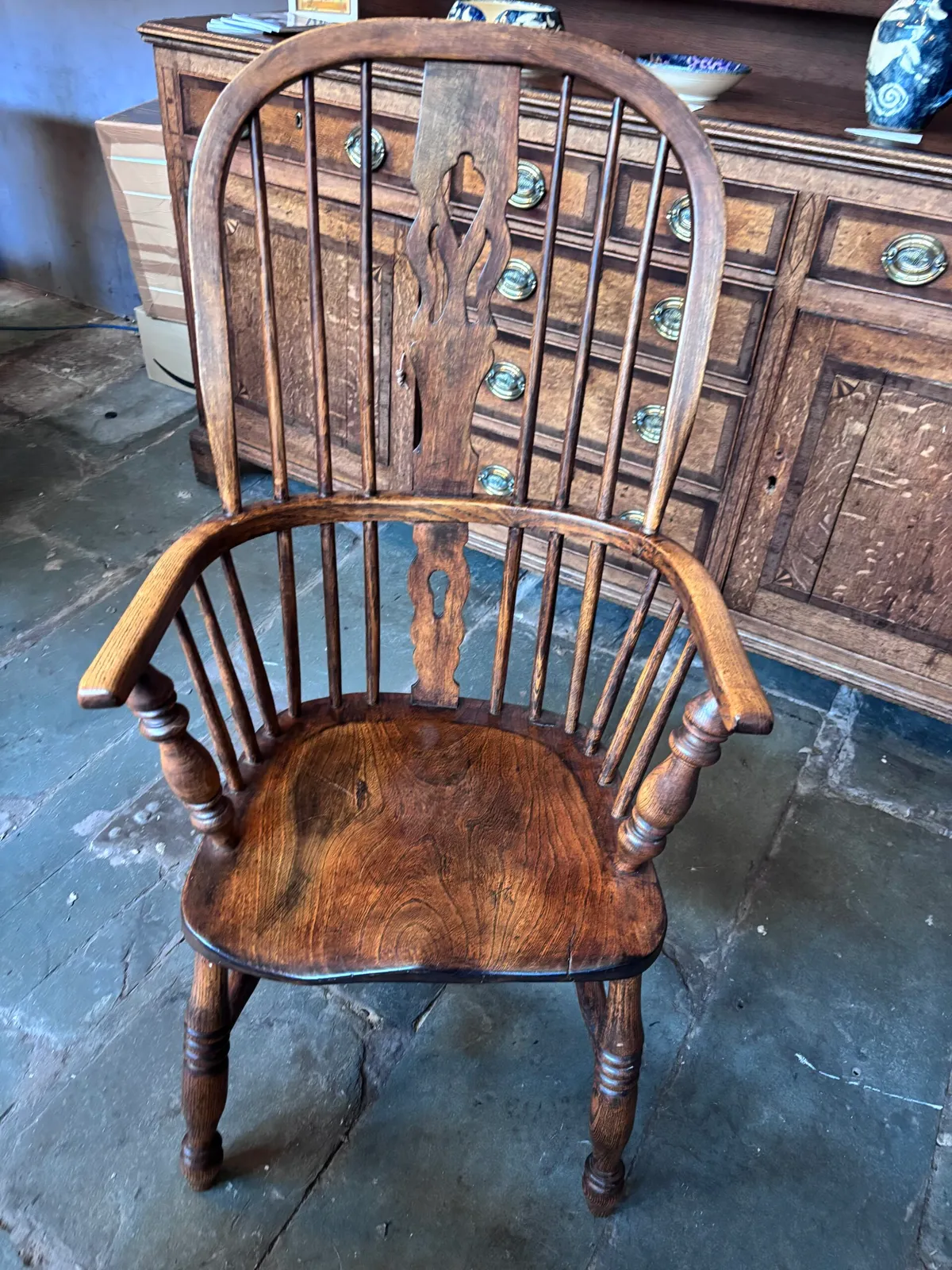
No.05
Windsor chair
Priced on Creative Caernarfon. Ask Sara whether it is still here.
Photographed in the collection, Plate 05
Antique Windsor Chair
A hooped-back Windsor armchair with a pierced central splat, spindle back, saddle seat and turned legs.
One-off. Ask whether it is still available.
Ask Sara about this pieceiii.
Buying from Caernarfon
Life: Full Colour has no Macclesfield branch; it is based in Caernarfon, on the far side of North Wales, reached by the M56 to Chester and then the A55.
Buying works the same way from anywhere: find a piece, ask Sara about it by the enquiry form or on 01286 400155, and buy through Creative Caernarfon.
Visiting and delivery
Life: Full Colour is based at 9 Segontium Terrace, Caernarfon LL55 2PN. Ask Sara whether delivery or viewing is possible for a particular piece.
Traditional country furniture listed on Creative Caernarfon
One-off pieces: ask Sara whether a listing is still available.
iv.
Questions for a Macclesfield buyer
Often, because much country furniture is modest in height and was made for working rooms. In a garret the limit is usually the low ceiling at the walls and the stair below it. Measure the headroom exactly where the piece would stand and the narrowest point of the stairs before you enquire about anything tall.
Broadly, furniture made by local joiners for farmhouses and cottages rather than for fashionable town houses: dressers, settles, chests, tables and chairs, usually in oak, ash, elm or pine. It is plainer than high-style furniture and often shows honest wear from use. Sara's pieces are sourced from Wales.
Cool rooms are generally kinder to old timber than very warm, dry ones. The bigger risks are sudden swings and persistent damp, such as a piece pushed hard against a cold outside wall. Leave a small air gap behind it and keep it a sensible distance from heaters and log burners.
Call Sara on 01286 400155 or write through the form on lifefullcolour.uk. Ask for any measurements you need, extra photographs of joints, feet or backboards, and whether viewing is possible and how delivery would be quoted for that piece. Purchases are completed through Creative Caernarfon.
Rungs polished smooth in the middle show years of feet resting on them, which is honest use. Look for rungs that wobble, crack at the ends or sit in loose holes. Check that the seat is not split and that the chair stands without rocking.
No, it is typical. Local joiners used what they had, so oak, ash, elm and pine could appear together, often with plainer timber in hidden parts. A mixed piece is not a poorer one, provided the timbers look consistent with each other and with the age of the piece.
Old repairs usually share the colour and wear of the surrounding wood, with dark, aged glue and softened edges. Recent ones look paler or sharper, with fresh glue or bright screws. Both are common, so the useful question is what was done and whether it is sound.
They offer clues, not proof. Hand-made nails, wooden pegs and slightly irregular screws suggest earlier work, while neat, uniform screws point to later making or repair. Fixings are often replaced over the years, so judge them together with the joints, the wear and the timber rather than on their own.
Seldom with certainty. Country furniture was made by local joiners with regional habits, but styles overlapped and pieces travelled, so a description that says probably is an honest judgement. Ask Sara what is known about where a particular piece may have been made.
They can, because hand tools leave faint ridges and uneven thickness on hidden surfaces. But machines and later makers can leave marks too, so they only add to the picture. Look at them with the wear, joints and colour before drawing any conclusion.
Natural wear gathers where hands, feet and bags actually touch: edges, arms, rails and front corners. Distressing tends to be even, random or too neat, with scuffs in odd places. If a piece looks aged on top but the underside looks new, ask more questions.